Adverb Worksheets Generator
Make adverb practice sheets – -ly forms, how/when/where/how often, frequency word order – and print them with answers.
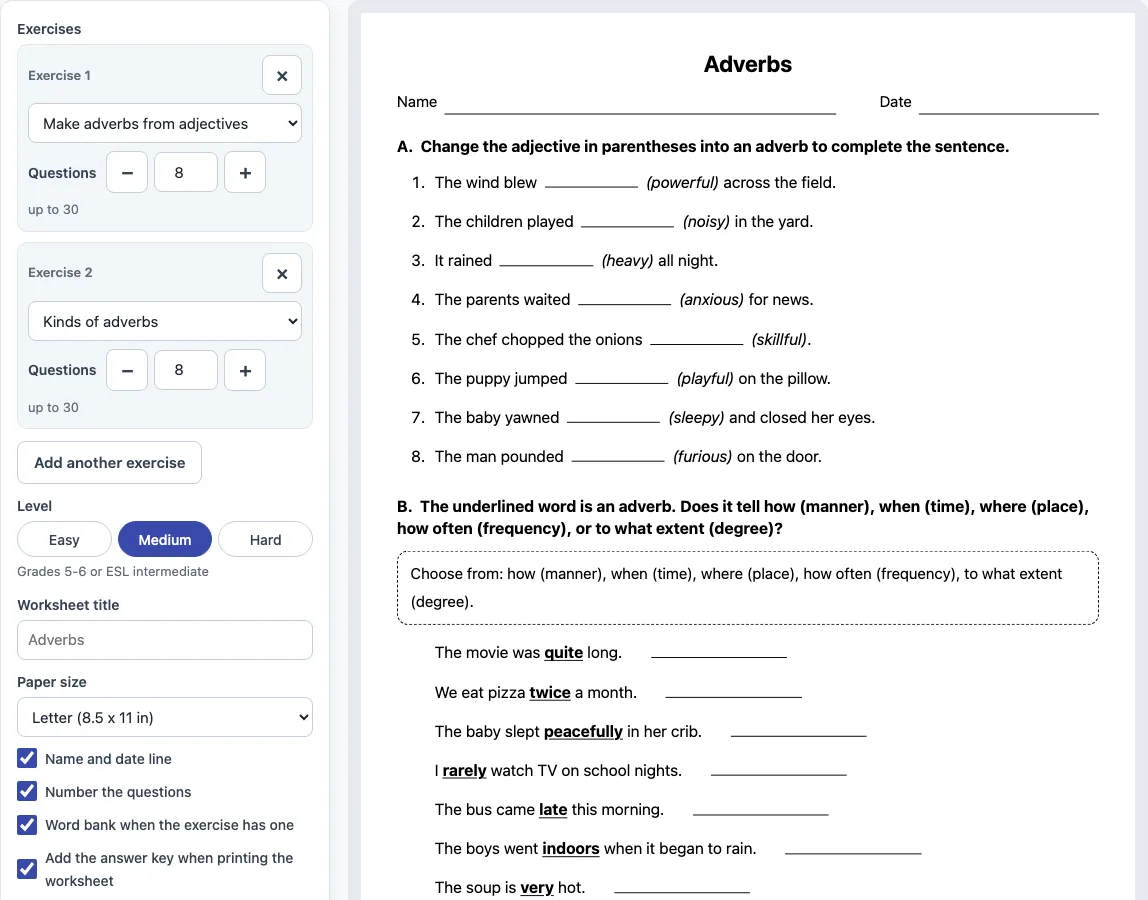
How to make an adverb worksheet
- Type a title in the worksheet title box, then choose US Letter or A4 paper.
- Choose a level: Easy, Medium or Hard.
- In the first exercise, pick an exercise type from the list and set the number of questions, from 3 to 30.
- Click “Add another exercise” to add more exercises, up to six in total, and repeat step 3 for each one. The default sheet has Make adverbs from adjectives (8) and Kinds of adverbs (8).
- Turn on the options you need: Name and date line, Number the questions, Word bank (for exercises that have one), and Add the answer key when printing.
- Check the preview on the right, which updates with every change. Click “New worksheet” if you want new questions with the same settings.
- Click “Print worksheet” to print the sheet, or “Print answer key” to print only the key.
Use Different versions (1 to 10) to create separate sets with their own questions and answer keys, which helps when learners might copy from each other. “Copy link” saves an address that opens exactly the same worksheet, so you can reprint it later or share it with a colleague. To practice on screen, click “Practice online”, answer, then click “Check answers” for a score.
What is an adverb?
An adverb is a word that tells more about a verb, an adjective or another adverb. Most adverbs answer one of these questions: how, when, where, how often, or to what extent. In “The students listened carefully to the story,” the word carefully tells how the students listened.
The worksheets use five kinds of adverbs:
- Manner tells how: slowly, carefully.
- Time tells when: yesterday, soon.
- Place tells where: outside, nearby.
- Frequency tells how often: always, rarely.
- Degree tells to what extent: very, extremely. This kind appears on Medium and Hard only.
Many adverbs come from adjectives by adding -ly, and the spelling changes follow a few rules:
- Add -ly: quick → quickly.
- Consonant + y becomes -ily: happy → happily, but shy → shyly.
- -le becomes -ly: gentle → gently.
- -ic becomes -ically: frantic → frantically. The exception is public → publicly.
- A few drop a letter: full → fully, true → truly. Good is irregular: good → well.
- Some keep their form: fast, hard, late, early and straight.
Where do adverbs of frequency go in a sentence?
Adverbs of frequency usually go in the middle of the sentence, close to the verb. The main ones are always, usually, often, sometimes, rarely, seldom, never and hardly ever.
They follow three patterns:
- After a form of be: The store is always open.
- Before the main verb: We usually eat pizza on Fridays.
- After the first helping verb: She has never visited Paris.
The “Where does the adverb go?” exercise asks learners to rewrite a sentence with an adverb of frequency in this usual position.
The Adjective or adverb exercise asks which form fits a sentence. In “The ___ sea was perfect for sailing,” the word describes the noun sea, so the adjective calm is right, not the adverb calmly.
You may use what you make at home, in class, in tutoring and in paid lessons; just do not resell the sheets as a product.
Frequently asked questions
Do the worksheets come with answers?
Yes. Select “Add the answer key when printing” to add the key on its own page, or use “Print answer key” to print only the key. Each version under Different versions has its own answer key.
Can I use the worksheets in paid lessons or sell them?
You can use them free at home, at school, in tutoring and in paid lessons, and you can copy them for your learners. Reselling the sheets as a stand-alone product, such as a printable pack, a workbook or a download, is not allowed under the terms of use.
How do you make comparative and superlative adverbs?
Short adverbs and flat adverbs add -er and -est, as in fast → faster → fastest. Most -ly adverbs use more and most, as in more carefully and most clearly. Some are irregular: well → better → best, badly → worse → worst.
Which level should I choose?
Easy suits grades 3 to 4 or ESL beginners, Medium suits grades 5 to 6 or ESL intermediate learners, and Hard suits grades 7 to 8 or ESL upper-intermediate learners. The level changes the sentences and words used.
Can learners check their answers on screen?
Yes. “Practice online” turns the sheet into an on-screen exercise. Learners tap a choice, type an answer or tap words, then select “Check answers” to see which items are right or wrong, the correct answers and a score. “Try again” resets the exercise. Free-writing items marked “Answers will vary” are not scored.
Related tools
- Adjectives worksheets: Use these before adverbs, since many adverbs are formed from adjectives.
- Parts of speech worksheets: Use these to practice adverbs alongside nouns, verbs and other word types.
- Verb worksheets: Use these when learners need more practice with the verbs that adverbs describe.
- Sentence structure worksheets: Use these to practice where words sit within a full sentence.
- Grammar worksheets: Use these for a broader set of grammar topics beyond adverbs.
- Subject-verb agreement worksheets: Use these when learners need practice matching verbs to their subjects in the sentences they write.