Conclusion Words
Find conclusion words and phrases by purpose and style, see each one in a sentence, and copy it or a fill-in-the-blank starter.
Recent
Your last 10 settings, saved only in this browser. Nothing is uploaded.
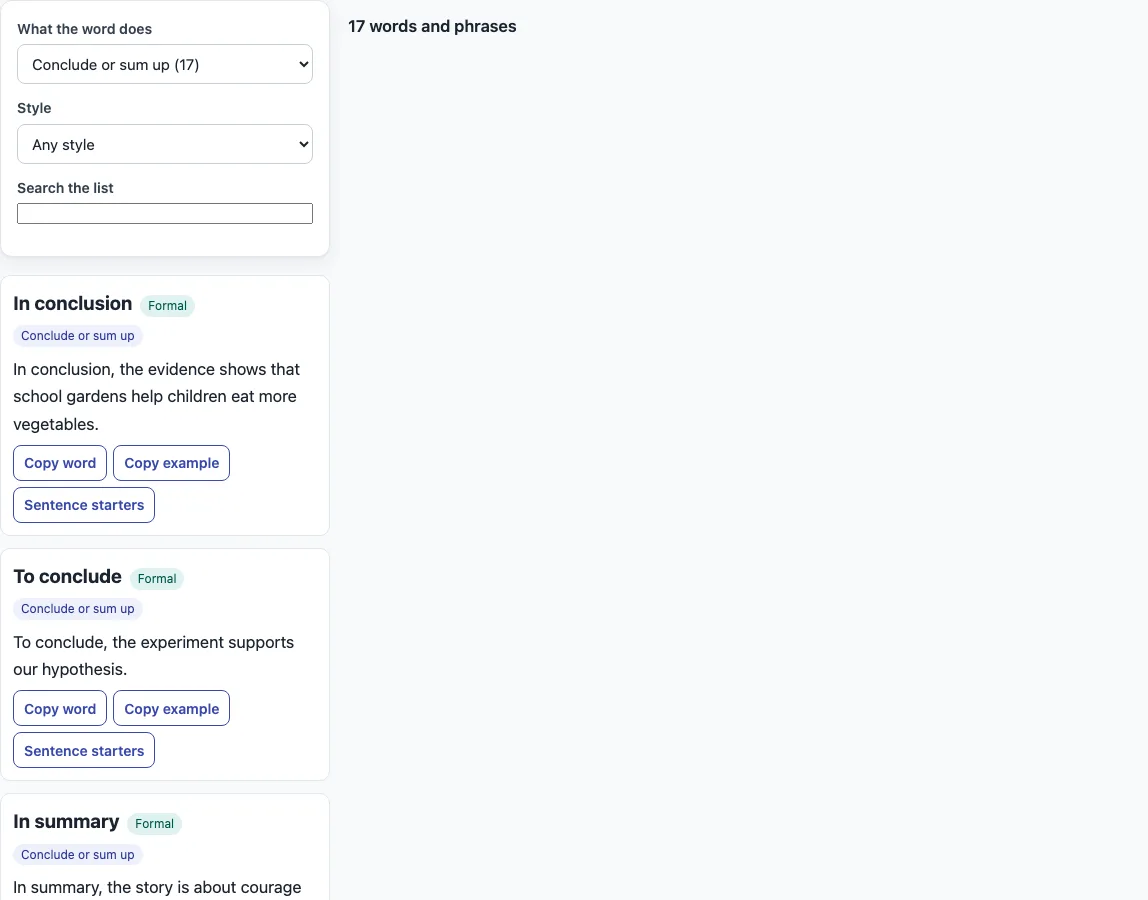
How to use the conclusion words list
- Open the page. It starts on the group “Conclude or sum up,” which holds the most common closing phrases.
- Open the “What the word does” menu and choose a group, such as “Show a result” or “Emphasize a point.” Each option shows how many words it contains.
- Open the “Style” menu and pick Formal, Everyday, or Informal. Choose “Any style” to see all of them.
- Type a word or idea into the “Search the list” box to narrow the cards further.
- Check the count above the cards to see how many words match your settings.
- Read each card. It shows the word, its style tag, what it does, and a full example sentence.
- Click “Copy word” to copy the word, or “Copy example” to copy the sample sentence.
- Click “Sentence starters” to open fill-in-the-blank frames for that word. Use the Copy button on any frame you want.
Once you have chosen a word, use its sentence starter as the first line of your closing sentence and fill the blanks with your own points. Read the finished sentence aloud to check that it sounds natural.
Your filter settings are saved in the page link. If you bookmark the link or send it to someone, the same filters will open.
What are conclusion transition words
Conclusion transition words are connecting words that tell the reader a piece of writing is ending, or how the final point follows from what came before. They work best at the end of a paragraph, essay, or speech, not in the middle, and they should match the logic of the paragraph. For example, use a result word only when the last sentence really follows from the earlier ones.
The list sorts these words into four groups. The first group, “Conclude or sum up,” includes In summary, To sum up, and All in all. The second, “Show a result,” includes Therefore, As a result, and So. The third, “Finish a list or sequence,” includes Finally, In the end, and Last but not least. The fourth, “Emphasize a point,” includes Indeed, In fact, and Truly.
How do you start a conclusion paragraph
Start a conclusion paragraph with a signal that the writing is ending, such as In conclusion, To sum up or Overall, followed by your main point in fresh words. Then recall the two or three key points of the piece in one or two sentences, and finish with a closing thought: what the reader should remember or do next. Do not add new evidence in the conclusion, because the reader expects a wrap-up, not a new argument.
Conclusion words are only the signal. The sentence after the signal does the real work, so use the sentence starters to get going and then write your own ideas.
Do you put a comma after in conclusion
Yes, you normally put a comma after In conclusion when it opens a sentence. A comma usually follows an introductory word or phrase, as in “In conclusion, the evidence supports the claim.”
Result words need different punctuation when they join two independent clauses. A semicolon often comes before them, followed by a comma: “The ice melted; therefore, the river rose.” Repeating the same word in every paragraph sounds repetitive, so choose from the list to vary your closings.
Frequently asked questions
What are some good conclusion words?
Good choices include In conclusion, To sum up, In short, Overall, and Therefore. Pick the one that matches the tone of your writing and the logic of your final point. The list shows each word with a style tag and an example.
What words can I use instead of “in conclusion”?
You can use To conclude, In summary, To sum up, In closing, or All in all (informal). In brief and Briefly are shorter. Choose based on how formal your writing is.
Do you put a comma after “in conclusion”?
Yes, in most cases. Place a comma after In conclusion when it starts a sentence, as in “In conclusion, the results were clear.”
Can I copy the words?
Yes. Use the “Copy word” button to copy a word, “Copy example” to copy its sample sentence, or the Copy button on a sentence starter. The site’s terms allow the output to be used for any purpose, including commercial use, and no credit is needed.
Is it free?
Yes. The list and every other tool on the site are free to use. Nothing you type is uploaded, because all the work happens in your browser.
Does the tool write my conclusion for me?
No. The tool gives you words, examples, and sentence starters, but you write the conclusion yourself. It also does not check grammar.
Related tools
- Tone words: Use this when you want to describe the mood or attitude of your writing, which can shape how you close a piece.
- Main idea worksheets: Practice identifying the main point, so your conclusion restates it accurately.
- Sentence worksheets: Build and check sentence structure, including the sentences that open and close a paragraph.
- Punctuation worksheets: Practice commas and semicolons, including where they go after introductory and result words.
- Synonyms and antonyms worksheets: Find alternatives to repeated words when you want more variety in your writing.
- Context clues worksheets: Practice working out word meanings from the sentences around them.