Context Clues Worksheet & Handout Generator
Sentences with one tricky word and a clue to its meaning – print a context clues sheet with answers or practice online.
This free context clues worksheet and handout generator creates printable practice sheets in your web browser. You choose the level, the exercise types and the number of questions, and it builds a sheet of sentences where learners work out word meanings from the text around them. It is free, needs no sign-up, and nothing you make is uploaded or sent to a server.
Each sheet can mix three exercise types. “What does the word mean?” asks learners to pick a meaning from four choices. “Name the context clue” asks which kind of clue helps. “Fill in the word” uses a word bank.
Use the output as a context clues handout, a set of activity sheets for class or homework, or a context clues worksheet PDF. You can add an answer key, so context clues worksheets with answers are ready to mark as soon as they print.
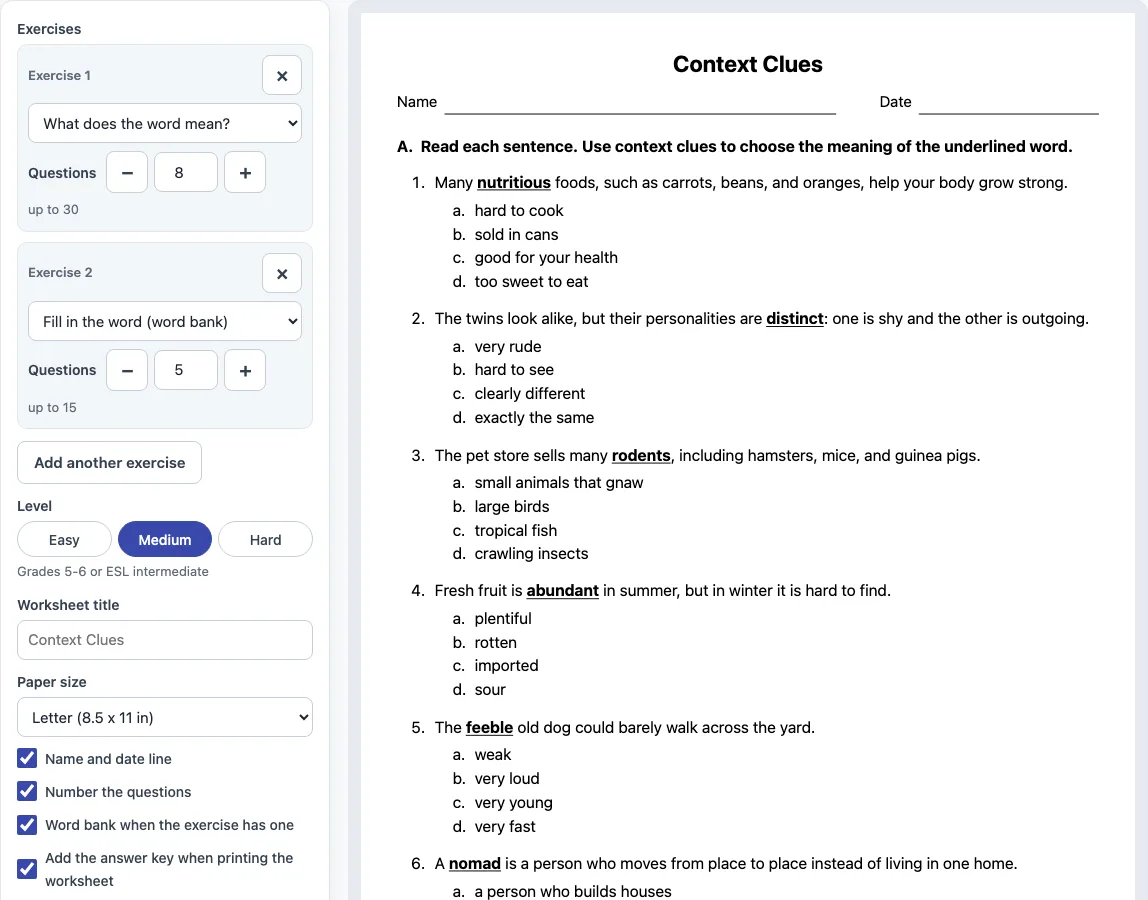
How to make a context clues worksheet
- Choose a level: Easy (grades 3–4 or ESL beginner), Medium (grades 5–6 or ESL intermediate) or Hard (grades 7–8 or ESL upper-intermediate).
- Set the exercises. The default sheet has “What does the word mean?” with 8 questions and “Fill in the word” with 5. Click “Add another exercise” for up to six exercises in total.
- For each exercise, pick an exercise type and a number of questions from 3 to 30. Match exercises count groups of pairs instead of single questions.
- Enter a worksheet title and choose US Letter or A4 paper.
- Tick Name and date line and Number the questions if you want them. Tick Word bank for exercises that have one.
- Tick Add the answer key when printing to include the key. Set Different versions from 1 to 10 if learners sit close together; each version has its own questions and its own key.
- Check the preview on the right, which updates with every change. Click “New worksheet” for new questions with the same settings.
- Click Print worksheet, or Print answer key for the key alone.
Click “Copy link” to get an address that opens exactly the same worksheet, which is useful for reprinting or sharing. To use the sheet on screen, click “Practice online”, then “Check answers” to see right and wrong answers and a score, and “Try again” to reset.
What are context clues and what types are there?
Context clues are the words and sentences around an unfamiliar word that help a reader work out its meaning. Readers use them when they cannot look up every word, such as while reading a story, an article or a science text.
The sentences on these worksheets use five kinds of clue:
- Definition: the sentence explains the word, as in “…impartial, which means she cannot favor either side.”
- Synonym: a nearby word means the same thing as the target word.
- Antonym: a contrast word such as unlike, but or instead signals an opposite meaning. For example: “Fresh fruit is abundant in summer, but in winter it is hard to find.”
- Example: words such as such as, for example or like introduce examples of the word.
- General sense: the whole sentence hints at the meaning, with no single signal word.
The “Name the context clue” exercise uses the first four types, so learners practice naming the kind of clue they see.
How do you use context clues to determine word meaning?
Read the whole sentence first, then the sentence before or after if the meaning is still unclear. Look for a signal word, a restatement or a contrast. Then test each answer choice by putting it into the sentence in place of the target word. Wrong choices are plausible words that the sentence does not support, so the test usually rules them out.
Word-bank sets follow the same logic. The generator never places two words with close meanings in the same set, so each blank has one answer that fits the context.
For example, in “It was so humid that our clothes stuck to us and the air felt wet,” the words “the air felt wet” rule out choices such as “dry and dusty” and point to “damp, with moisture in the air.”
You may use what you make at home, in class, in tutoring and in paid lessons; just do not resell the sheets as a product.
Frequently asked questions
Are there PDF worksheets for using context clues to determine word meaning?
Yes. Make your sheet, click Print worksheet, then choose “Save as PDF” in the print window. Set the scale to 100 % and turn off headers and footers so the PDF matches the preview.
Do the worksheets come with answers?
Yes. Turn on “Add the answer key when printing” to print the key on its own page, or use “Print answer key” to print only the key. Each version in “Different versions” has its own answer key.
Which grade is this for?
Easy suits grades 3–4 or ESL beginners, Medium suits grades 5–6 or ESL intermediate, and Hard suits grades 7–8 or ESL upper-intermediate. The level changes the words, from Easy words such as enormous and humid to Hard words such as impartial and prudent. Choose the level that matches your learners’ reading, not only their age.
Can I use the worksheets in paid lessons or sell them?
You can use them in paid lessons, tutoring and classes, and you can copy them for your learners. You may not resell them as a stand-alone product, such as a printable pack, a workbook or a download.
Can learners check their own answers?
Yes, with “Practice online”. Learners tap or type their answers, then “Check answers” marks each item right or wrong and shows the score.
Related tools
- Vocabulary worksheets: use these when you want practice with word meanings beyond sentence clues.
- Synonyms and antonyms worksheets: use these for drilling the word pairs that power synonym and antonym clues.
- Inference worksheets: use these when learners need to draw conclusions that the text does not state directly.
- Main idea worksheets: use these to practice finding the central point of a passage.
- Idioms worksheets: use these when phrases have meanings that the words alone do not reveal.
- Homophones worksheets: use these to practice words that sound alike but have different meanings and spellings.