Homophones Worksheet Generator
Their, there, they're and more than 100 other homophone sets in real sentences – print a worksheet with answers or practice online.
A homophones worksheet is a printable practice sheet where learners choose, fix and match words that sound the same but have different spellings and meanings, such as flour and flower. This free homophones worksheet generator builds one for you in a few clicks. It runs in your web browser, needs no sign-up, and nothing you make is uploaded or sent to a server.
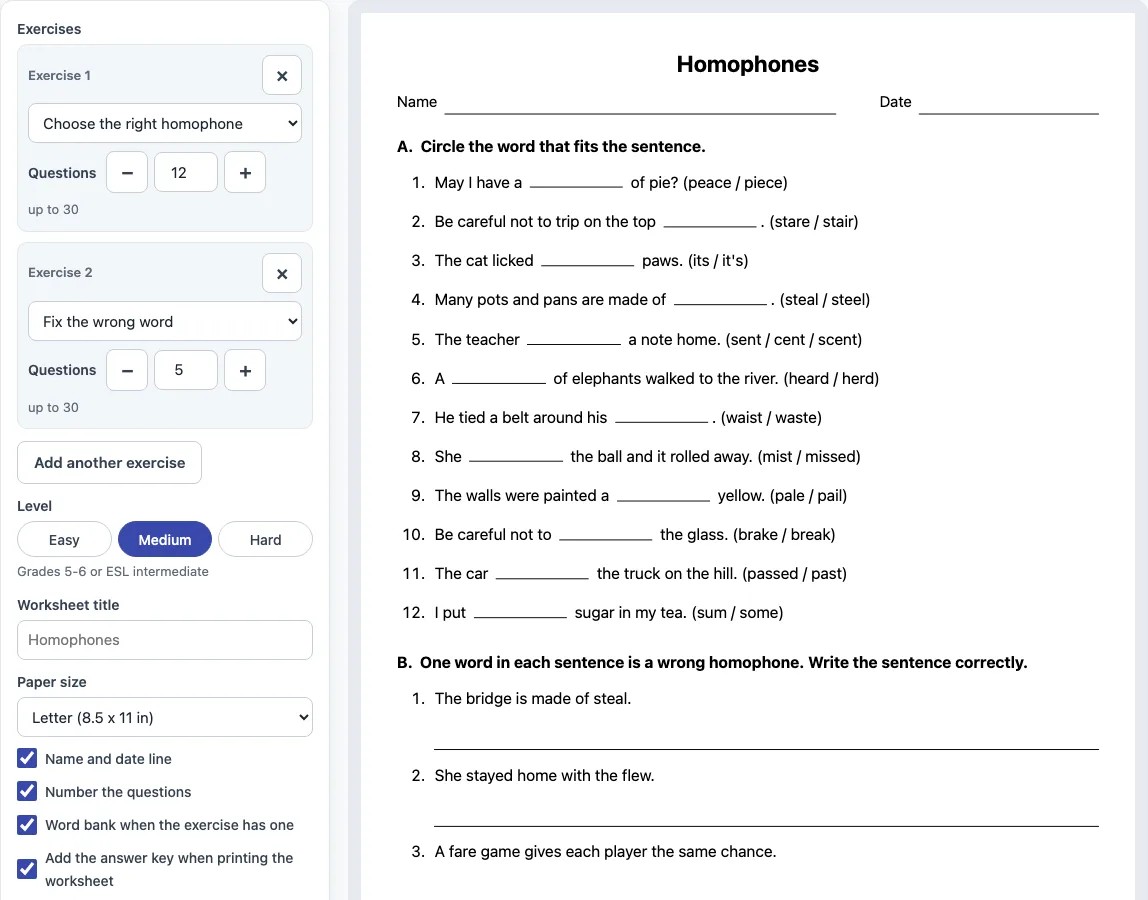
You choose the level, the exercise types and how many questions each exercise has. The preview on the right shows the paper sheet and updates as you change settings, so you can check it before printing. Use the result as a homophone sheet for a warm-up, a homophones activity sheet for a group, or a set of homophones exercises for homework. All sentences were written for the site and checked by hand, and the word sets use American English pronunciation.
How to make a homophones worksheet
- Pick a level. Easy suits grades 3–4 and ESL beginners. Medium suits grades 5–6, and Hard suits grades 7–8.
- Build your exercises. The default sheet has Choose the right homophone (12 questions) and Fix the wrong word (5 questions). To change an exercise, pick its exercise type and set the number of questions from 3 to 30. Select ‘Add another exercise’ to use up to six exercises.
- Set the title and paper. Type a worksheet title and choose US Letter or A4.
- Turn on the options you need. These include Name and date line, Number the questions, Word bank for exercises that have one, and Add the answer key when printing.
- Set Different versions from 1 to 10 if learners sit side by side. Each version has its own questions and its own answer key.
- Check the preview. It updates with every change. Select ‘New worksheet’ to get new questions with the same settings.
- Print. Select Print worksheet, or Print answer key to print only the key.
Copy link saves an address that opens exactly the same worksheet. To use the sheet on screen, choose Practice online. Learners tap a choice, type an answer or tap words, then select ‘Check answers’ to see each item marked right or wrong, the correct answer and a score. ‘Try again’ resets it. To save a PDF, choose ‘Save as PDF’ in the print window, set the scale to 100 %, and turn off headers and footers.
What are homophones?
Homophones are words that sound the same but have different meanings and usually different spellings. Common examples are flour and flower, blue and blew, and to, too and two.
The sound gives no clue about the spelling, so readers need the context to know which word is meant. The tool’s Fix the wrong word exercise uses this idea. For example, “She wore a ribbon around her waste” is wrong because waste means something you throw away, so the correct word is waist. Easy sets use everyday pairs such as sea and see, while Hard sets include principal and principle.
The other exercise types test the same idea in different ways. Choose the right homophone asks learners to circle the word that fits a sentence. Write a homophone asks for the matching word, such as through and threw. Match words and meanings pairs words like new and knew with their meanings. Which word means…? asks learners to pick the word that fits a definition, such as weight rather than wait.
What is the difference between homophones and homographs?
Homophones sound the same but are spelled differently. Homographs are spelled the same but have different meanings, and sometimes different sounds. For example, a bow on a gift and a bow to the audience are spelled the same way, but they mean different things and are pronounced differently.
Homonyms is an umbrella term that is sometimes used for both groups. This tool practices homophones only, so its exercises do not include homographs. If your class also works on homographs, use a separate sheet for them.
On Easy, the wrong word in Fix the wrong word is underlined; on Medium and Hard, learners have to find it themselves, which is closer to proofreading their own writing.
You may use what you make at home, in class, in tutoring and in paid lessons; just do not resell the sheets as a product.
Frequently asked questions
Do the worksheets come with answers?
Yes. Turn on Add the answer key when printing to place the key on its own page after the worksheet. Use Print answer key to print only the key. Each version has its own answer key.
Can I get the worksheet as a PDF?
Yes. Select Print worksheet, choose ‘Save as PDF’ in the print window, set the scale to 100 %, and turn off headers and footers.
Which homophones are right for 3rd and 4th graders?
Choose the Easy level for grades 3–4. It uses everyday sets such as blue/blew, to/too/two, there/their/they’re, right/write, sea/see and bye/buy/by, with short sentences.
Can I use the worksheets in paid lessons or sell them?
You can use the sheets at home, at school, in tutoring and in paid lessons, and you can copy them for your learners. You may not resell them as a stand-alone product, such as a printable pack, a workbook or a download.
Does the tool include homographs?
No. The tool practices homophones only. Homographs are not part of any exercise type.
Can learners do the homophones worksheet online?
Yes. Click Practice online, and learners tap the word that fits or type their answers. Check answers marks each item right or wrong, shows the correct word and gives a score; Try again starts over.
Related tools
- Contractions worksheets: Use these when learners need practice joining two words, such as do not into don’t, and to tell its from it’s.
- Vocabulary worksheets: Use these to build word knowledge beyond sound-alike pairs.
- Synonyms and antonyms worksheets: Use these to practice words with similar or opposite meanings.
- Punctuation worksheets: Use these to practice commas, periods and other marks in sentences.
- Context clues worksheets: Use these to help learners work out a word’s meaning from the sentence around it.
- Grammar worksheets: Use these to practice sentence structure and word forms.