Idioms Worksheet Generator
Common English idioms in real sentences – print a worksheet with an answer key or practice the meanings online.
How to make an idioms worksheet
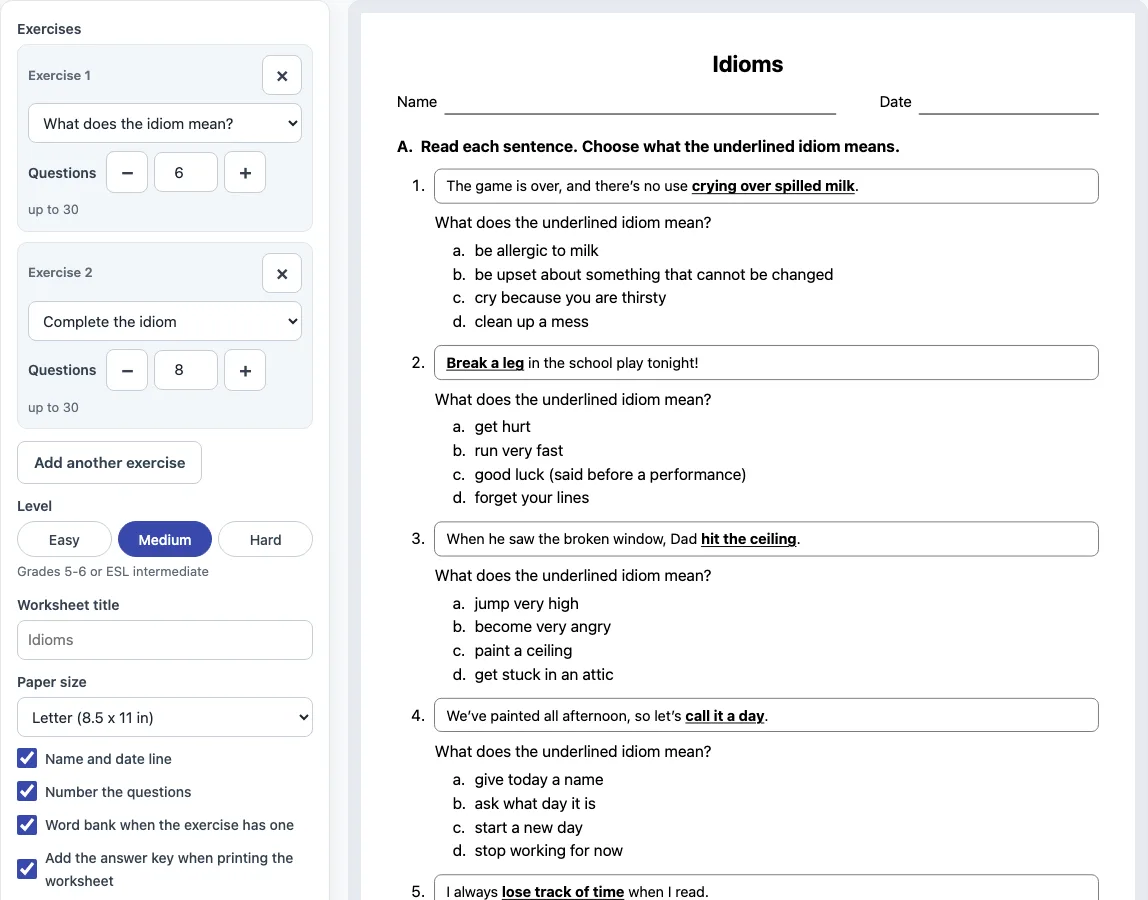
- Enter a worksheet title, then choose the paper size, US Letter or A4. Turn on Name and date line if learners will write on the sheet.
- Choose a level: Easy (grades 3–4 or ESL beginner), Medium (grades 5–6 or ESL intermediate), or Hard (grades 7–8 or ESL upper-intermediate).
- Open the first exercise and pick an exercise type from the select menu. The default sheet uses What does the idiom mean? with 6 questions and Complete the idiom with 8.
- Set the number of questions for each exercise, from 3 to 30. You may get fewer if the level has fewer items.
- Select Add another exercise to build a sheet with up to six exercises.
- Check the preview. It updates after every change. Select New worksheet to get new questions with the same settings.
- Turn on Number the questions, Word bank (for exercises that have one), and Add the answer key when printing.
- Set Different versions from 1 to 10. Each version has its own questions and answer key.
Select Print worksheet to print the sheet, with the answer key on its own page if you chose that option. Select Print answer key to print only the key. Copy link saves an address that opens the same questions. Practice online turns the sheet into an on-screen exercise. Learners tap a choice, type an answer, or tap words, then select Check answers to see each result and a score. Try again resets the exercise.
What is an idiom?
An idiom is a fixed phrase whose meaning cannot be worked out from the meanings of its single words. For example, “break the ice” means to start a friendly conversation, and nothing about ice or breaking explains that. Idioms are a kind of figurative language, and many come from older everyday life.
Learners often read idioms literally, which is why the sheets place each idiom in a sentence. The surrounding words usually show the meaning. In “That new bike costs an arm and a leg,” the talk about cost points to “be very expensive.” Wrong answer choices often include the literal reading, so a learner who thinks “a piece of cake” is about dessert has to stop and think about the figurative meaning. Idioms with similar meanings are never offered as choices for the same question, so each item has one right answer.
How do you teach idioms with activity sheets?
Teach idioms by moving from meaning to use. Start with Match idioms to meanings, so learners see the phrase and its meaning side by side. Easy sheets use common phrases such as “under the weather” and “up to you,” which gives learners a base to build on.
Next, use Complete the idiom. A learner who fills in “colors” for “passed with flying ___” has to recall the whole phrase, not just understand it. Which idiom fits? goes one step further. The learner reads a short situation, such as heavy rain stopping a game, and chooses “raining cats and dogs” from the options. This shows whether the learner can apply the idiom to a real context.
At Medium and Hard levels, Literal or idiom? asks learners to decide whether a phrase such as “up in the air” is figurative in a given sentence. Talking through each answer helps learners notice when a phrase is being used literally and when it carries its idiomatic meaning. Finish with a short writing or speaking task, using the idioms in sentences of their own.
Frequently asked questions
Are these suitable for ESL learners?
Yes. Choose the level that matches your learners: Easy for ESL beginners, Medium for ESL intermediate, and Hard for ESL upper-intermediate. The level changes which sentences and words are used, so the sheets grow with your learners.
Do the worksheets come with answers?
Yes. Turn on Add the answer key when printing, and the key prints on its own page. To print only the key, select Print answer key.
Can I get the worksheet as a PDF?
Yes. Select Print worksheet and choose Save as PDF in the print window. Set the scale to 100 % and turn off headers and footers.
Can I use the worksheets in paid lessons or sell them?
You can use them in paid lessons, tutoring, at home, and at school, and you can copy them for your learners. You may not resell the sheets as a stand-alone product, such as a printable pack, a workbook, or a download.
Can learners check their own answers?
Yes, with Practice online. Each item is marked right or wrong, and the correct answer is shown. Items marked “Answers will vary” are not scored.
Do I need to sign up or install anything?
No. The idioms worksheet generator is free and runs in your web browser. Nothing you make is uploaded or sent to a server.
Related tools
- Similes and metaphors worksheets: Use these when learners are ready to compare figurative language beyond fixed phrases.
- Context clues worksheets: Use these to help learners work out unfamiliar words from the sentences around them.
- Vocabulary worksheets: Use these to build a wider word bank alongside idiom practice.
- ESL conversation exercises: Use these to practice speaking, so learners can try out idioms in dialogue.
- Synonyms and antonyms worksheets: Use these to practice word meanings that are close to or opposite each other.
- ESL worksheets generator: Use this to mix idioms with grammar and vocabulary exercises on one sheet.