Inference Worksheet & Practice Sheet Generator
Short reading passages with questions that make students read between the lines – printable, with an answer key.
This inference worksheet generator makes a printable inference sheet in your web browser. It is free, and you do not need to sign up. Each sheet has short passages where the answer is never stated, so learners work it out from clues in the text and what they already know.
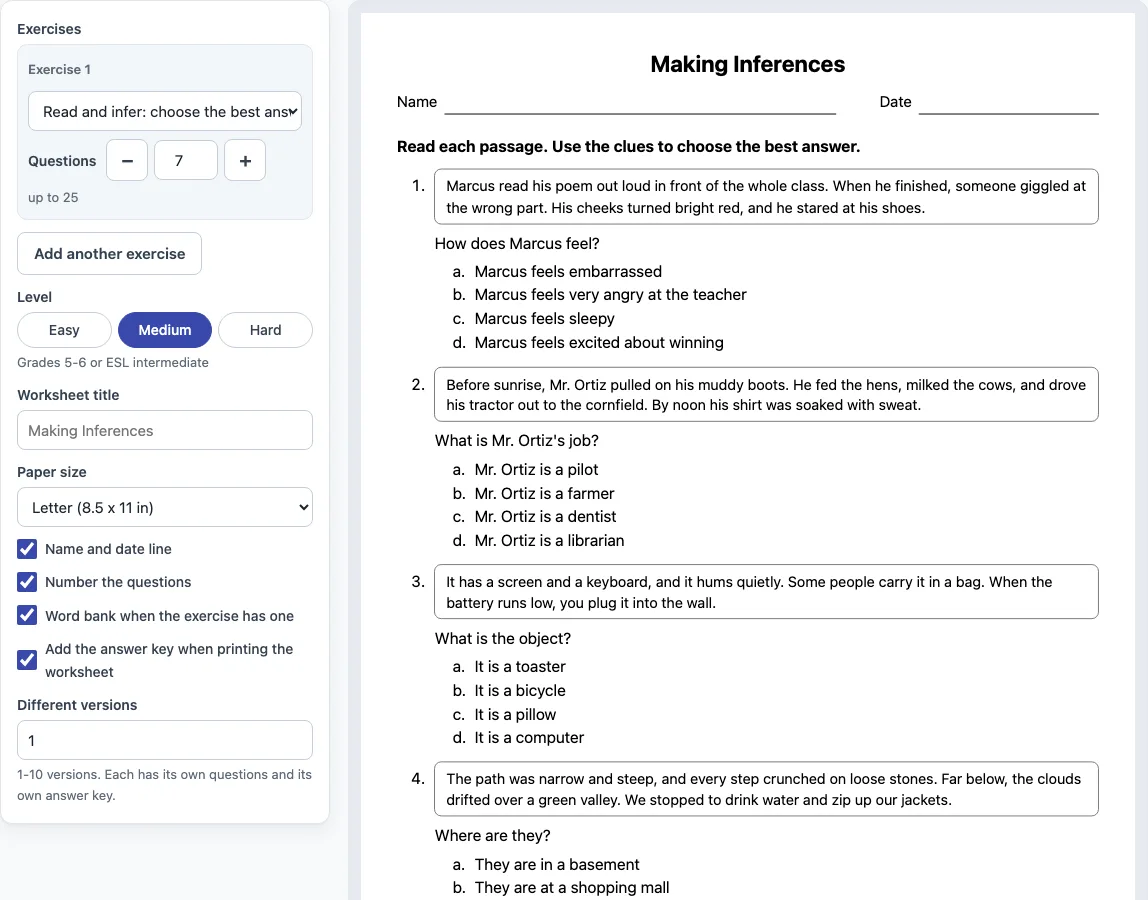
You choose the level (Easy, Medium or Hard), the exercise types and the number of questions. The preview on the right shows the paper sheet and updates as you change settings. You can print the sheet with or without an answer key, or use it on screen as a practice exercise that checks answers. Teachers use it for making inferences worksheets in class, drawing inferences and finding inferences worksheets for homework, or a quick inference handout or inference practice worksheet before a test.
How to make an inference worksheet
- Choose a Level: Easy, Medium or Hard. The level changes the passages and questions.
- In the first exercise, pick an exercise type. The default is Read and infer, with 7 questions. Find the clue words and Write your own inference are available at Medium and Hard.
- Set the number of questions for that exercise, from 3 up to the number of passages the level has (25 for Read and infer).
- Select Add another exercise to add more exercises, up to six in total. Each one has its own type and number of questions.
- Type a worksheet title and choose US Letter or A4 paper.
- Turn on the options you want: Name and date line, Number the questions, Word bank (for exercises that have one), and Add the answer key when printing.
- Set Different versions from 1 to 10 if you want more than one version of the sheet.
- Check the preview. Select New worksheet to get new questions with the same settings.
- Select Print worksheet to print the sheet, or Print answer key to print only the key.
Select Copy link to save an address that opens exactly the same worksheet, with the same questions. This is useful for reprinting later or sharing with a colleague. To have learners answer on screen, select Practice online. Tap the choice, type the answer or tap the words, then select Check answers to see each item marked right or wrong, the correct answer and a score. Try again resets the exercise.
What is an inference?
An inference is a conclusion you reach from clues in a text combined with what you already know. The text gives the clues, your background knowledge links them, and the conclusion is the inference. The passages on these sheets never state the answer directly.
Take this passage from the Easy level: “Sara packed her towel, sunscreen, and a bucket. Her brother carried a big ball. The car was loaded and the family was ready to go.” The passage never says “beach.” Readers use what they know about towels, sunscreen and buckets to conclude that the family will probably go to the beach.
Inference questions in these worksheets ask where something happens, who a person is (often by job), how someone feels, what will probably happen next, what time or weather it is, why someone did something, or what an object is. The wrong choices are not supported by the clues, and some are contradicted by them. So ask which answer the clues support best. Each item has one best answer.
How do you teach making inferences?
Teach it as a routine. For every passage, ask three questions: What do the clues show? What do I already know about this? What is the most likely conclusion? Then move learners through the exercise types in order.
Start with Read and infer at the Easy level. Learners read two or three short sentences and choose from three or four options. Once they are comfortable, move to Medium, where Find the clue words gives the inference and asks learners to find the phrase in the passage that supports it. For example, the inference “Jin is at an airport” is supported by “watched a plane roll slowly along the runway.”
Finish with Write your own inference. Learners state what they can infer and point to the clue that helped them. Answers will vary, so discuss them as a class instead of marking them right or wrong. Hard passages run four to six sentences, which gives learners more clues to weigh.
You may use what you make at home, in class, in tutoring and in paid lessons; just do not resell the sheets as a product.
Frequently asked questions
What is the difference between an observation and an inference?
An observation is something you can see or read directly. An inference goes beyond it. “The trays clattered” is an observation, while “it is lunchtime” is an inference, built from the sound plus what you know about meals.
Do the worksheets come with answers?
Yes. Select Add the answer key when printing to put the key on its own page, or Print answer key to print only the key. Each version has its own answer key. In Practice online, items marked “Answers will vary” are not scored.
Can I get the worksheet as a PDF?
Yes. Select Print worksheet, then choose Save as PDF in the print window. Set the scale to 100 % and turn off headers and footers so the PDF matches the preview.
Can I use the worksheets in paid lessons or sell them?
You can use the sheets free at home, at school, in tutoring and in paid lessons, and you can copy them for learners. You may not resell them as a stand-alone product, such as a printable pack, a workbook or a download, under the terms of use.
Can I make different versions of the same worksheet?
Yes. Set Different versions from 1 to 10. Each version has its own questions and its own answer key, which helps stop learners copying from each other in class.
Is my worksheet uploaded anywhere?
No. The generator runs in your browser, and nothing is uploaded or sent to a server.
Related tools
- Main idea worksheets: use these when learners need to identify the central point of a passage.
- Context clues worksheets: use these when learners need to work out a word’s meaning from the words around it.
- Similes and metaphors worksheets: use these when learners are working on figurative comparisons.
- Vocabulary worksheets: use these for practice with word meanings and word use.
- Sentence structure worksheets: use these when learners need practice building and reading sentences.
- Idioms worksheets: use these when learners are working out phrases whose meaning is not literal.