Similes and Metaphors Worksheet Generator
Practice figurative language with simile and metaphor sentences – printable sheets with answers, new questions every click.
This free similes and metaphors worksheet generator makes printable practice sheets for figurative language. Choose the exercise types, level and number of questions, and the sheet is ready to print or to try on screen. It runs in your web browser with no sign-up, and nothing you create is uploaded or sent to a server.
You can build a simile worksheet, a metaphor worksheet, or a mixed identify simile and metaphor worksheet. There are also meaning checks and writing tasks, so the same sheet can cover simile exercises and writing similes and metaphors. Easy, Medium and Hard levels suit grades 3 to 8 and ESL learners. Answer keys are optional, so you can print the sheet alone or with similes and metaphors worksheets with answers. You may use what you make at home, in class, in tutoring and in paid lessons; just do not resell the sheets as a product.
How to make a similes and metaphors worksheet
- Set the worksheet title. Type it in the title box.
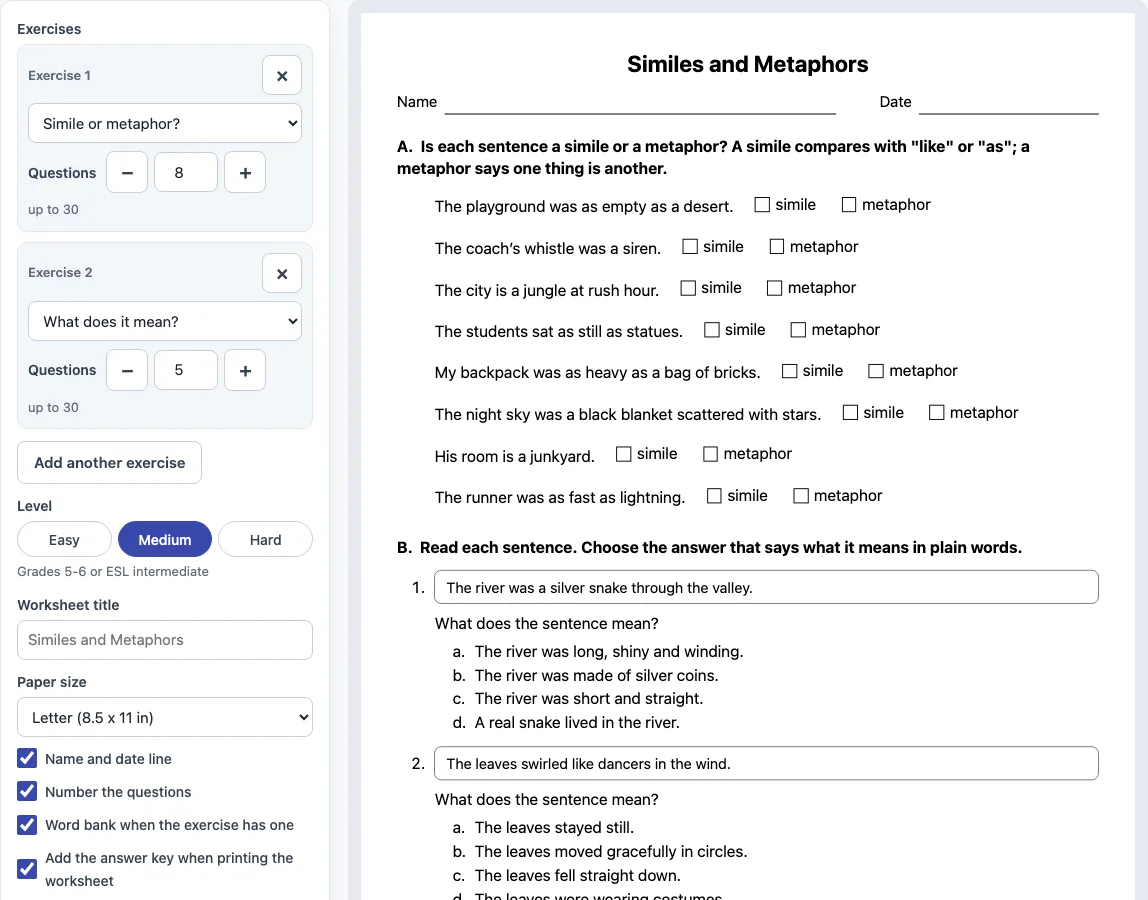
- Choose an exercise type for the first exercise. The options are Simile or metaphor?, What is compared?, What does it mean?, Complete the simile and Write your own. The default sheet uses Simile or metaphor? (8 questions) and What does it mean? (5 questions).
- Set the number of questions for that exercise, from 3 to 30.
- Click “Add another exercise” to add more, up to six exercises in total.
- Pick a level: Easy, Medium or Hard.
- Choose paper size, US Letter or A4.
- Turn on the options you need: Name and date line, Number the questions, Word bank (for exercises that have one) and Add the answer key when printing.
- If you want versions for a class, set Different versions from 1 to 10. Each version has its own questions and answer key.
- Check the preview on the right. It updates as you change settings. Click “New worksheet” to get new questions with the same settings.
- Click “Print worksheet” to print the sheet, or “Print answer key” to print only the key.
Click “Copy link” to save an address that opens exactly the same worksheet, so you can reprint it later or send it to a colleague. To use the sheet on screen, pick “Practice online”. Click “Check answers” to see each item marked right or wrong, along with the correct answers and a score. Click “Try again” to reset.
What is the difference between a simile and a metaphor?
A simile compares two different things using the word like or as. A metaphor says that one thing is another, without like or as. Both are figurative language, so neither is meant literally.
Here is a simile: “Her eyes sparkled like diamonds.” The words like and as make the comparison clear. The writer does not mean that her eyes are made of diamonds. The phrase “as busy as a bee” works the same way.
Here is a metaphor: “The library was a harbor of calm.” The library is not literally a harbor. The writer says that it gives the same sense of shelter and quiet that a harbor gives a boat.
A quick test is to look for like or as. If one of them is there, the sentence is probably a simile. If one thing is stated to be another, it is a metaphor.
Examples of similes and metaphors
Common fixed similes such as “as light as a feather” or “as fresh as a daisy” use everyday comparisons, and the Complete the simile exercise asks learners to fill in the missing word. In “The playground was as empty as a desert,” the two things compared are the playground and a desert, which is what the What is compared? exercise asks learners to find.
Hard sentences use more literary comparisons, such as “His anger was a pot ready to boil over.” This is a metaphor. It says that anger is like a pot about to overflow, without using like or as.
The What does it mean? exercise checks the plain meaning of a figure of speech. For example, “Her words were a warm hug” means “Her words made me feel comforted.” Learners choose the plain meaning from the options.
The sentences leave out personification, hyperbole and idioms. This keeps each example clearly a simile or a metaphor, so learners can practice the difference without confusion.
Frequently asked questions
Do the worksheets come with answers?
Yes. Turn on “Add the answer key when printing” to print the key on its own page after the sheet. “Print answer key” prints only the key. Each version in Different versions has its own answer key.
Can students write their own similes?
Yes. The Write your own exercise gives prompts such as “Write a simile about: a snowy morning” or “Write a metaphor about: the ocean.” The answer key says “Answers will vary,” and these items are not scored in Practice online.
Can I get the worksheet as a PDF?
Yes. Click “Print worksheet”, then choose “Save as PDF” in the print window. Set the scale to 100 % and turn off headers and footers.
Can I use the worksheets in paid lessons or sell them?
You can use the sheets for free at home, at school, in tutoring and in paid lessons, and you can copy them for learners. You may not resell them as a stand-alone product, such as a printable pack, a workbook or a download.
Can students check their answers on screen?
Yes. In Practice online, learners tap a choice, type an answer or tap words. Then “Check answers” marks each item right or wrong, shows the correct answer and gives a score. Free-writing items are not scored.
Are the sentences checked?
All sentences were written for this site and checked by hand. They use American English spelling.
Related tools
- Idioms worksheets: use these when learners need to understand phrases whose meaning is not literal, such as “break a leg.”
- Context clues worksheets: use these when learners need to work out an unfamiliar word from the sentences around it.
- Adjectives worksheets: use these to practice describing words, which often appear in similes and metaphors.
- Vocabulary worksheets: use these to build word knowledge before or after figurative language work.
- Inference worksheets: use these when learners need to work out meaning that the text does not state directly.
- Main idea worksheets: use these when learners need to find the central point of a passage.