Subject-Verb Agreement Worksheet & Practice Sheet Maker
Pick the exercises and level, then print a subject-verb agreement sheet with an answer key – or practice it online.
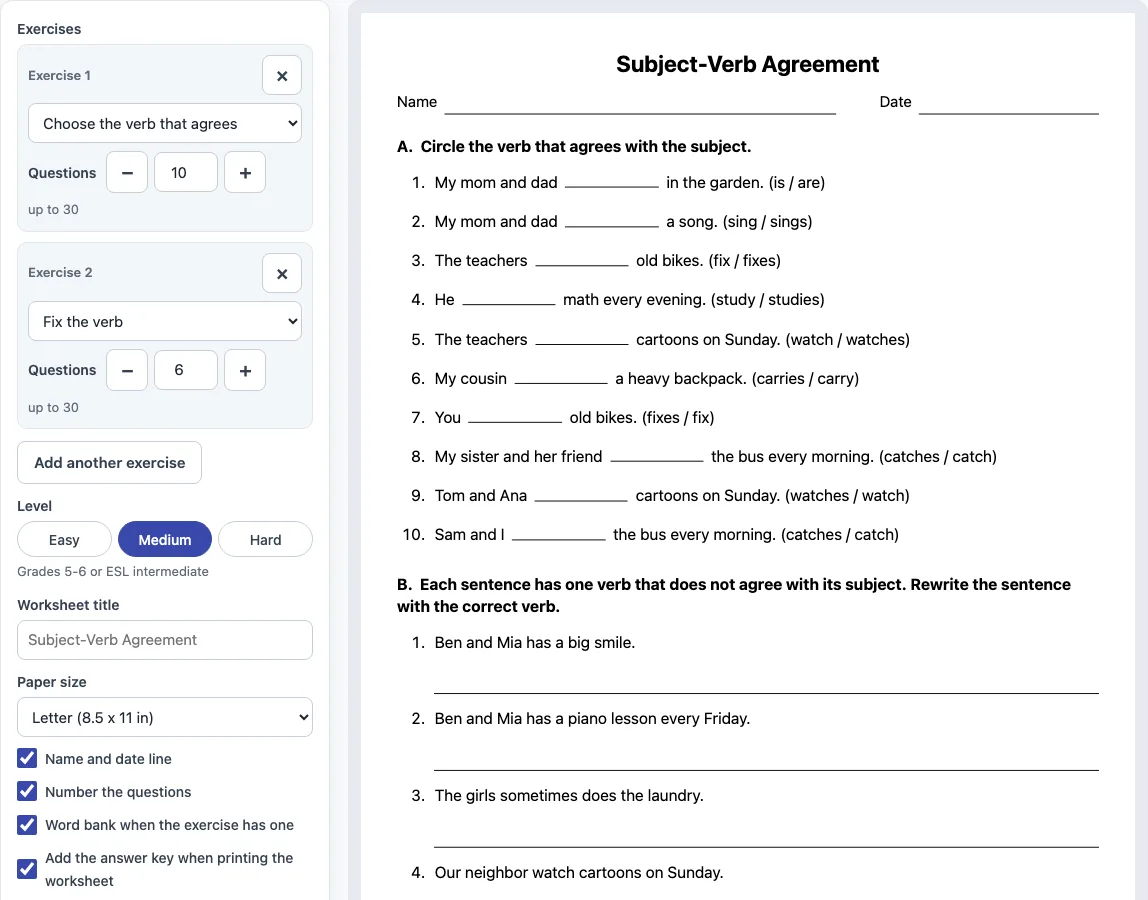
How to make a subject-verb agreement worksheet
- Choose a level: Easy, Medium or Hard. The level changes which sentences and words are used.
- Pick an exercise type and a number of questions (3 to 30) for the first exercise.
- Click ‘Add another exercise’ to add up to six exercises in total, and repeat step 2 for each one.
- Type a worksheet title and choose US Letter or A4 paper.
- Turn on the options you need: Name and date line, Number the questions, Word bank (for exercises that have one), and Add the answer key when printing.
- Check the preview on the right. It changes as soon as a setting changes. Click ‘New worksheet’ to get new questions with the same settings.
- Click ‘Print worksheet’. Click ‘Print answer key’ if you want only the key.
- To try the sheet on screen, click ‘Practice online’. Tap a choice or type an answer, click ‘Check answers’ for a score, and ‘Try again’ to reset.
Set Different versions (1 to 10) to give each student a different copy, which helps against copying in class. Each version has its own answer key. Copy link saves an address that opens the same worksheet with the same questions, so you can reprint it later or share it with a colleague. To save a PDF, choose ‘Save as PDF’ in the print window, set the scale to 100 %, and turn off headers and footers.
What is subject-verb agreement?
Subject-verb agreement means the verb in a sentence matches its subject in number. A singular subject takes a singular verb, and a plural subject takes a plural verb. For example, “The dog barks” uses a singular subject and verb, while “The dogs bark” uses plural forms of both.
What are the subject verb agreement rules?
Find the subject first – not the noun closest to the verb – then choose the verb form that matches it. These are the rules the exercises practice:
- A singular subject takes a singular verb: “The dog barks.”
- A plural subject takes a plural verb: “The dogs bark.”
- I and you take the plural form: “I eat,” “you eat” (but I am, you are).
- Two subjects joined by and take a plural verb: “Ben and Mia do not want any soup.”
- With or, either…or and neither…nor, the verb agrees with the nearer subject: “Neither Sam nor my brothers need a ride.”
- Everyone, everybody, someone, nobody, each, either and neither take a singular verb: “Everyone in my class enjoys music.”
- Both, few, many and several take a plural verb.
- A phrase between the subject and the verb does not change the verb: “One of the books is missing.”
- With along with and as well as, the verb agrees with the first subject.
Present-tense forms follow spelling rules. Most verbs add -s (walk → walks). Verbs ending in s, x, z, ch, sh or o add -es (watch → watches, go → goes). A consonant plus y changes to -ies (carry → carries). The irregular forms are have → has, be → am/is/are, and do → does.
Most mistakes happen when the subject is hard to spot: when a phrase sits between the subject and the verb, or when the subject comes after the verb, as in “There are two cats on the porch,” where cats is the subject.
You may use what you make at home, in class, in tutoring and in paid lessons; just do not resell the sheets as a product.
Frequently asked questions
Do the worksheets come with answers?
Yes. Turn on ‘Add the answer key when printing’ to put the key on its own page after the sheet. Each version in Different versions has its own key, and ‘Practice online’ marks each answer right or wrong.
Can I get the worksheet as a PDF?
Yes. Click ‘Print worksheet’, choose ‘Save as PDF’ in the print window, set the scale to 100 %, and turn off headers and footers.
Which level should I choose?
Choose Easy for grades 3–4 or ESL beginners, which use pronouns and singular or plural nouns. Choose Medium for grades 5–6 or ESL intermediate learners, which adds compound subjects with and, phrases between subject and verb, and there is / there are. Choose Hard for grades 7–8 or ESL upper-intermediate learners, which adds everyone, each of, either…or, neither…nor, along with and as well as.
Can I use the worksheets in paid lessons or sell them?
You can use them free at home, at school, in tutoring and in paid lessons, and you can copy them for your learners. You cannot resell them as a stand-alone product, such as a printable pack, a workbook or a download, under the terms of use.
Can each student get a different version?
Yes. Set Different versions from 1 to 10. Each version has its own questions and its own answer key, which makes copying harder in class.
Why are words like “team,” “all” or “some” not included?
They are left out on purpose. Collective nouns such as team and family, and words like all, some, none and most, can take a singular or plural verb depending on meaning, so they would make the answer unclear.
Related tools
- Verb worksheets: use these for practice with verb forms before you move on to agreement.
- Verb tenses worksheets: use these when learners need to choose between past, present and future verb forms.
- Noun worksheets: use these to review singular and plural nouns, which set the verb form in agreement exercises.
- Pronoun worksheets: use these to practice I, you, he, she and they as subjects.
- Sentence structure worksheets: use these to find the subject and verb in a sentence before checking agreement.
- Grammar worksheets: use these for a wider range of grammar topics alongside agreement practice.
- Conjunctions worksheets: use these to practice and, or and nor, which often join subjects in agreement exercises.